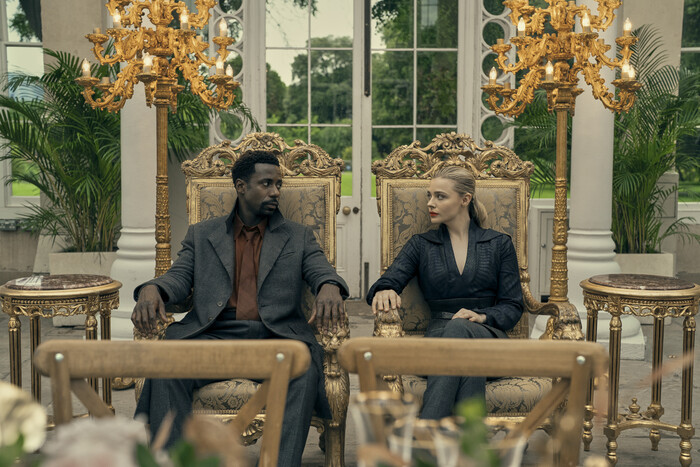
The first season of the new series by creative duo Lisa Joy and Jonathan Nolan ended on Amazon Prime last Friday. Does it live up to the expectations set by (the first season of) Westworld? The Peripheral is an engaging, albeit at times, frustrating cerebral drama. And it’s here to let you know: The future is much, much more royally screwed than you thought. Spoilers ahead!
Not too long after the wrap-up of Westworld, a show that really should have ended after its first, bombastic season, Peripheral, the television series adaptation of the 2014 book of the same name hit Amazon Prime in October. Going by its marketing, Amazon meant this series to be one of its flagship brands for the fall of 2022. And just like Rings of Power challenged House of the Dragon for the title of “the iconic fantasy drama of its time,” Peripheral comes at a time where we need another intellectual sci-fi series.
Westworld set the bar very high, but a select few of us also have an Expanse-sized hole in our weekly series watching schedule. One of the most cherished traditions of sci-fi is to use fiction to bring out and expose our societal fears. And The Peripheral aims to do that. Does it succeed in creating a compelling narrative?
The world
In The Peripheral, we are actually introduced to two worlds. This might make it harder for a non-sci-fi-nerd viewer to follow which technology is from where and who is connected to which plotline and how.
One world, the already somewhat screwed-up near future of 2032, is where our protagonist, Flynne Fisher (Chloë Grace Moretz) lives. We don’t know too much about this future. But we know that people use VR routinely, order items to be printed in their neighborhood 3D print shops, electric vehicles are commonplace – Oh and US marines can link their minds using neural implants that make them effective killing machines but also give veterans terrible chronic pain. We also know that Texas at the very least tried to secede from the United States, leading to a civil war in the 2020s. We also get hints that the welfare state of America is on the verge of collapse.
Flynne and her brother, Burton Fisher (Jack Reynor) scrape by to make ends meet. Their mother has cancer, which made her blind and they have to buy her drugs from the thugs of the local kingpin, Corbell Pickett (Louis Herthum). Dear upstanding-citizen (and totally not ruthless drug lord) Mr. Pickett is the biggest entrepreneur in the town and also has the sheriff department in his pocket. So don’t let the idillic Americana fool you, this town is rotten to the bone.
The other timeline that we are introduced to makes 2032 rural America look like a utopia. Through technology and quantum entanglement and some timey-wimey sci-fi tech magic, in the first episode Flynne ends up visiting the mid-far future of 2099 by piloting a robot assassin through a VR headset. The future of 2099 is a bleak, de-facto dystopia. The world has went through a series of cataclysmic events known as the Jackpot, a wide-scale systems collapse that brought down the entire global world throughout the 21st century.
The Jackpot is a series of independent but often interconnected events. Cyberwarfare, a global pandemic (yes this is where we start nervously shifting in our seats), environmental catastrophe and famine, antibiotic failure, followed by the collapse of agriculture and global famine, and finally, nuclear terrorism.
The world of 2099 London, the setting that Flynne is thrown into, is one where the remnants of society are trying to rebuild civilization. Cruel factions rule what is left of the UK, maintaining a fragile power balance. One member of this triumvirate is a private tech conglomeration called the Research Institute. Another is the shady underworld oligarchy known as the Klept, a vaguely Russian network of crime boss families that Flynne is forced to ally with. And the third is the Metropolitan Police, with the strength of the law and enhanced android officers behind them. No, not the public servants with a heart of gold from crime procedurals. Imagine Peaky Blinders-style police. Baton first, questions later. But it’s a pretty android lady that bashes your face in.
The story and characters
The series has a non-linear narrative. In their rural hometown, Flynne works in a shop that prints 3D objects on demand. Meanwwhile ex-marine and war veteran Burton is a pro power leveling gamer for hire. He is basically payed by other players to help them get though harder levels in online VR games. Flynne is a more talented gamer than her brother though, so she helps him out from time to time. She uses her brother’s avatar however, since the average gamer would not trust a woman in a video game.
The concept of “pro gamer” is not a novel idea anymore (this happens when a 2014 book is adapted in 2022). But the part where Flynne has to hide that she’s a woman in an online video game hits the nail on the head. Yeah, the creators do understand the toxic wasteland that is gaming culture today.
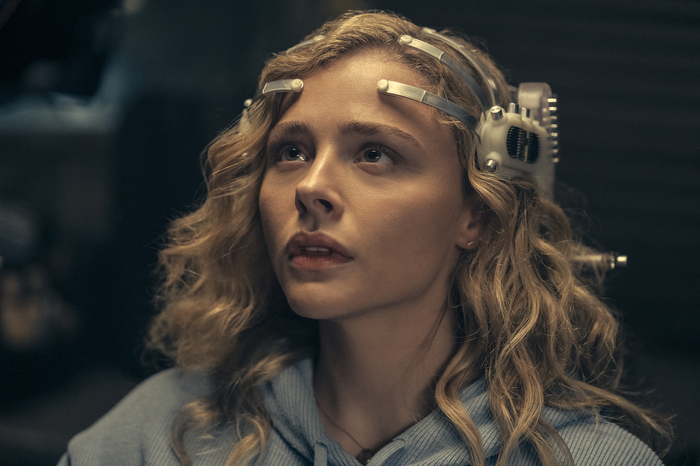
For his outstanding scores in VR games, Burton gets a special offer by a mysterious Colombian developer company. He is offered a lot of money to test a new game. He pawns the job off to his sister who really made his high score happen. Putting on a cutting-edge experimental VR gear that offers much better immersion than any other before, Flynne dives in to test away.
Pretty soon we find out that the futuristic London that she is sent into is in fact the real world, our other timeline, many decades in the (farther from our POV) future. We also find out that Flynne is operating a real-life cybernetic robot body. Those cyberbodies are called peripherals. (Hey that’s the title of the thing!) Plus her employer is actually a rogue operative who has a bone to pick with the timeline’s powers that be. Flynne powers through her quest in this weirdly bleak future London that is dominated by titanic and eerily gothic megabuildings shaped like Greek statues. Still believing that she is playing a game, she acquires the season’s MacGuffin, a data package stored in a maximum security corporate lab.
This propels her and her family into the middle of the deadly shadow war of the factions of the far future.
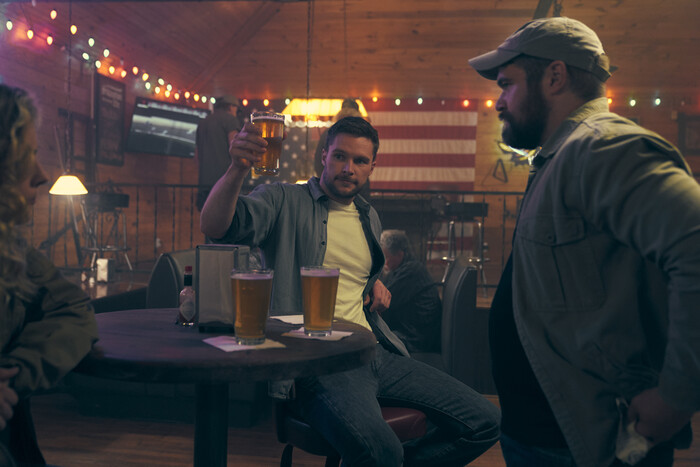
The story interchanges between the two timelines as Flynne travels back and forth, diving from time to time into a peripheral made for her. The plot also gradually unpacks the baggage of its characters. When their family is threatened, Burton calls in his Marine veteran buddies and they start dispatching hitman after hitman sent to kill Flynne. In this near future, Marines can link up through neural implants to work like a hive. While Burton & Co. organize their defense in their native 2032 timeline, in 2099 London, Flynne makes an alliance with a Klept oligarch in order to find her employer. They have to achieve this before the Research Institue, the faction that she stole the data from, kills all of them. Adversity and strange bedfellows after all.
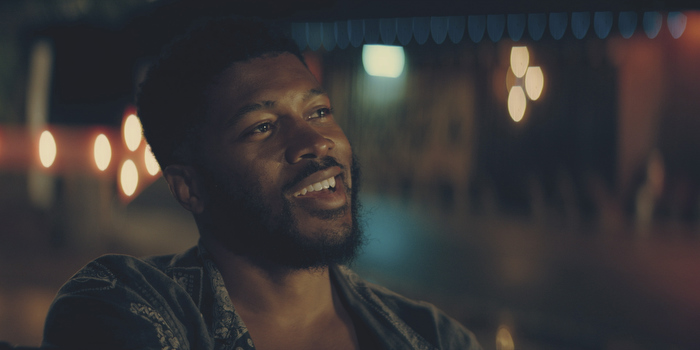
The plot explores the changing power dynamics of the opposing factions. It also unpacks a lot of personal baggage – Like how Conner (Eli Goree), a triple-amputee and estranged member of Burton’s veteran crew still struggles with his past and his disabilities.
Or how in Flynne’s timeline local sheriff deputy Tommy (Alex Hernandez) has to come to terms with the fact that all his boy scout goodness cannot cut through the wide-scale corruption of his town.

For her part, Flynne is a great protagonist. Her hand-to-hand combat prowess is mostly unexplained (especially since the future-diving VR is not piloted using a controller, the peripheral that she is sent into operates like her body.) Flynne is driven and gifted on the one hand, and vulnerable on the other. She has a childhood crush she’s still not over. She constantly bickers with her brother back and forth. When the future tech starts causing her neurological problems, she is visibly anxious and afraid. We get the feeling that Flynne isn’t a 2D cardboard cut-out femme fatale.
Meanwhile, her brother Burton is also layered and intriguing. The people who steal the show however, are the side characters. Corbell Pickett is an excellent villain, and so is the head of the Research Institute, Cherise Nuland (T’Nia Miller). Inspector Ainsley Lowbeer (Alexandra Billings) of the Metropolitan Police is the closest we get to a good guy and even she is a cruel and cunning power player in the cutthroat politics of her time.
Often however, the story, especially the logic of the timelines, gets overly convoluted. Long periods of runtime are dedicated to slow-burn character drama and flashbacks into various pasts, followed by bursts of exposition and plot advancement that the viewer will scramble to understand. This is especially true for the mind-blowing cliffhanger finale. The ending takes too little time to set up and then follows through with a truly mind-boggling plot twist. It comes a little bit out of left field and we have to look up explanation videos on YouTube to try to understand it.
My takeaway
It is quite fitting that The Peripheral came out in a time that is arguably a cyberpunk renaissance. From the start, I had this feeling that this series has found something that might just be the successor to cyberpunk as a genre.
For starters, it operates on the same premise. Sometime, starting in the next few years, the future will screw us over. All of our anxieties will come true, one by one, and within the timescale of a couple of generations. And somehow, technology will be a part of that.
Speaking of which, don’t let the neon lights and the allure of the futuristic cityscape fool you, that’s the true heart of cyberpunk. Our relationship with technology, our relationship with each other as a society. Class struggle and exploitation. The corruption of the powerful and the wealthy.
That’s also the premise that The Peripheral builds on. And it makes you dread the future again. It is easy to escape to cyberpunk because ultimately, it’s a future that didn’t come true. Street warfare between violent gangs is a hallmark 1980s fear, one that is so far removed from the average Western viewer in the 2020s that it doesn’t really upset us. Neon signs with advertisements everywhere? Please. My phone knows my own secrets better than I do.
The futures of 2032 and especially 2099, however, that this series presents us with are not just believable. They are terrifyingly believable. There really is no telling when the next pandemic will hit. Climate change is already leading to localized agriculture failures. The early signs of crisis might range from seemingly mild annoyances (lettuce shortage in Australia) to unsettling (millions of tons of cereals lost in Europe to the 2022 summer drought). On other fronts, too, we see the signs that of crises over the horizon. They might look too far and abstract for us to deal with (antibiotics resistance). They might not seem all that present or threatening (cyberattacks against the electrical grid).
But put together, they are all legit fears that we recognize. The future of The Peripheral is compelling because we know that it might not all play out exactly like this, but we live in a world where our sense of security in the global world has already shattered. The previous generations thought that communicable diseases could be vanquished and pandemics will be a thing of the past. Now we know that all we had was a brief respite. We also know that food shortages are much, much more likely to happen than we previously thought.
In short, The Peripheral shows a future that resonates with a generation whose retirement plan, jokingly, is to “die in the climate wars.” There is one scene in which Flynne’s partner in crime and kind of love interest, Wilf, shows her that most of the people she sees on the street and the buildings across the river are just augmented reality filters – Most of the buildings in London are ruined and the streets are empty. That’s when you understand how darker our generation’s anxiety is today. The cyberpunk of the 1980s envisioned a dystopian future in which the streets are full of neon lights to numb the atomized society of late-stage capitalism. In that future, we all live under the corporate yoke. The Peripheral envisions empty streets because most of us will just die.
This is also where the frustration comes in. This series goes into so many directions, it crams so much into one short, eight-episode season. Future-diving VR technology. Three-way political power struggles in the future. Small town corruption. Exploitation by the wealthy and powerful. War. Trauma. The PTSD of veterans. It’s very hard to find the common thread that connects all of these themes.
But if there is one shared theme among these topics and plotlines is that in every timeline, people will try to make ends meet. They will have to work around the system and do what they can. If there is one core message I can see it’s this: The powerful are screwing us over and ruining the world. But we’ll pick up the pieces and do what we can.
 PopCulture Station
Hozzászólás