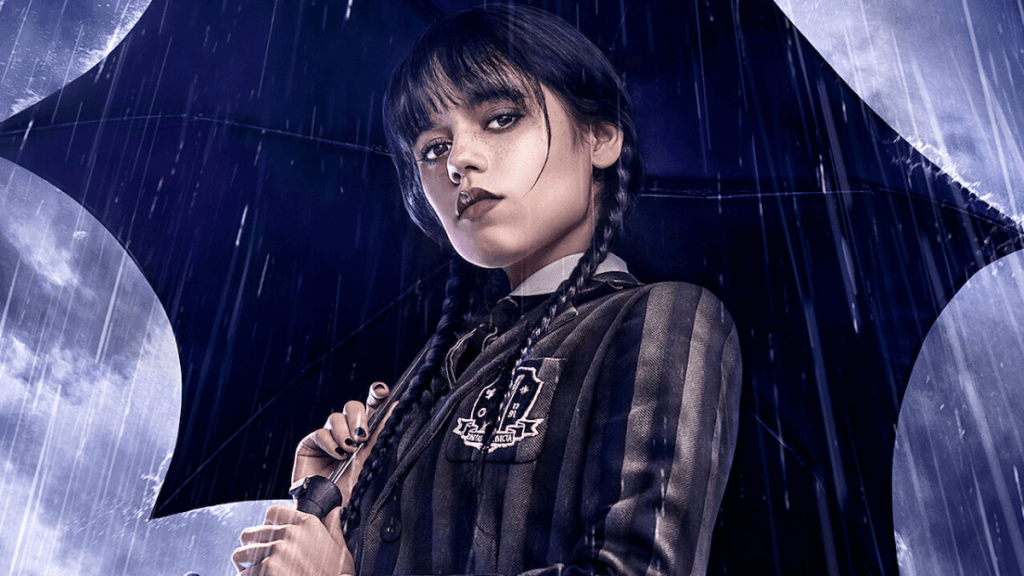
The Addams Family enters the streaming age with an expanded universe of its own. Wednesday is a Gen Z-era teenage mystery/crime/urban fantasy hybrid. It’s a fun ride, even though not everything works in this otherwise convincing 8-episode adventure. Thoughts on Season 1 – Warning: spoilers ahead!
Sequels, prequels, reboots are notoriously hit or miss. That is true for the Addams. The Addams Family, a group of beloved, goofy and macabre aristocrats has been a part of popular culture since the 1930s. Most of us however, know them from their incarnation in the 1991 and 1993 movies. That particular interpretation is deeply ingrained in our contemporary popular culture canon. The series Wednesday takes a leap and reimagines them in the 2020s.
Adventures at Nevermore
In the very first episode the series hits the ground running and immediately expands the lore and the world of the Addams. The rapid expansion of this world quickly stretches the source material thin. Within an episode we don’t even recognize that this is an Addams family show. We are thrown into yet another teenage drama, in yet another urban fantasy world, with yet another off-brand Hogwarts knockoff wizarding school.
Yet the story is decently paced, charming and grabs our attention. It works. And that’s not something I expected from a series that tries to shoehorn TikTok into the world of the Addams Family. Most important of all, in Wednesday Addams (Jenna Ortega) gives us a lovable protagonist who is a hero of self-empowerment.
In this 8-episode season Wednesday is sent to a boarding school of like-minded misfits after having been kicked out of a series of “normal” high schools. Wednesday Addams is an apparently cold-hearted and misunderstood weirdo. She siccs comically bloodthirsty piranhas on the jocks who bully her little brother. She is self-reliant, highly violent and frightening. She has a stubborn sense of justice. And after her latest incident with the aforementioned piranhas, her parents finally send her to their own alma mater, the Nevermore Academy. We then learn that there is a whole society of outcasts out there in the world. These are people with abilities that range from weponized 19th-century gothic Edgar Allan Poe edginess to straight-up magic.
Nevermore Academy is located in the outskirts of a peaceful New England town. Here we see a whole bunch of tropes slammed into the Addams’ world. It’s a magic school, in an urban fantasy setting in a small American town that is dealing with a series of mysterious murders. This is the depth of the the gravity well of hte past twenty years of popular culture.
There are student groups in Nevermore that make up various fantasy species or factions. We have psychics, werewolves, sirens, gorgons and vampires, and there is even a “secret” group of outcasts, the “hydes”. These groups are all instrinsically, often comically archetypical. The sirens are the popular kids. The werewolves are kind of jocks. The stoners (gorgons) are made to look like stereotypical … Well, stoners. We have every configuration of the goth-prep/jock-nerd matrix translated into a fantasy magic high school student society.
Wednesday immediately gets entangled in both teenage wizard hijinks and her own amateur investigation of the town’s mysterious disappearances. In the end, these storylines converge. Wednesday learns about friendship and trust and whitewashed American history. Through a well-paced eight-episode ride that spans the school semester, she discovers that the season’s mystery is linked to her family’s own history. By episode 8, the storylines conveniently coalesce into an action-packed finale that’s almost perfect for the season.
What works and what doesn’t?
At first you can’t help but wonder: Was this reboot really needed? Did we really want to explore another wizarding school, this time in the style of the Addams brand of gothic romantica?
The story of the Addams family is a very good case study in rebellion against societal norms. The Addams, in their 1990s interpretation, were the perfect guilty pleasure. This aristocratic family was the perfect idol of pushing back against society for anyone who didn’t fit into the middle class utopia of the 1990s and 2000s. The Addams, as characters, didn’t need to be three-dimensional. Their collision with high school bullies and suburban Karens was fun and entertaining enough. They offered a fresh take on how to oppose a number of things society easily turns a blind eye to, from bullying to whitewashing colonial history.
Wednesday takes this concept and expands on it. The series imagines an entire world of outcasts. And this society of misfits involves some heavy queer coding as well as broad themes that a 2020s audience can recognize. What happens when sub-groups within an ostracized group further discriminate those with multiple disdvantages? What’s the difference between a sincere political ally and a virtue signaling politician?
In this, I firmly believe that the series could have gone further. Nevermore offers a glimpse into a world where the “misfits” of society struggle with their internal stigmas and intra-group discrimination. It shows a world where some misfits are swept under the rug and locked in the closet to maintain the fragile balance with mainstream society. However, the series glosses over the uncomfortable but very important topics. Like how the murderous monster was in large part created by criminal negligence on the part of the school’s leadership. How a young man is exploited and groomed to be a killer by an adult teacher at the school. How one entire group of outcasts is just criminalized by their outcast society.
One example of the series shying away from delivering on its most promising themes is the character arc of Enid (Emma Myers). Enid is Wednesday’s bubbly werewolf roommate. She and Wednesday are each other’s character foils. Their friendship has a surprisingly charming opposites-attract chemistry. Enid’s cross to bear is her inability to “wolf out.” She cannot fully transform into her ultimate werewolf form. She faces a lot of pressure and judgement for this from her peers and even her family.
In one emotionally charged scene, on a family day at school, her mother gives her leaflets for what are basically “werewolf conversion camps”. With an outburst she tells her mother and her whole family that she will wolf out on her own time or never at all. The entire scene cannot be seen as not queer coded – And it offers an interesting glimpse into the intra-group traumas and stigmas of our “outcasts.” In the series finale however, Enid does the predictable thing and finally wolfs out at just the right moment to fight the BBEG and save Wednesday.
This is the perfect example of the series going into a bold new direction and then shying away at the last second. Because how amazing would it have been if Enid simply never wolfed out? If her family had to learn to accept her for who she is? And more importantly, if she discovered that she was perfect the way she was?
The most important part of the series however, is the protagonist Wednesday herself. Jenna Ortega does not let anyone steal the show. She takes the character of Wednesday and fills her with such passion and charisma that you can’t not get invested in her story. Every masterful facial expression, every stance, volume, emphasis fills in the character with subtle details about her personality and brings a relatively average character concept to life as a unique heroine. She’s not just a believable Wednesday Addams. She is our canon Wednesday Addams now.
It’s no secret that many viewers believe this Wednesday might have autism. This is never confirmed in the series. However, her constant struggles in the face of social interaction all but spell out “neurodivergent”. And that’s important. It’s important in 2022 to have a competent and lovable character who might also be on the autism spectrum.
On the one hand, representing neurodiversity in a positive way, through a well-crafted and well-acted character is very rare. It should be cherished. On the other hand, it is very important for society to understand the struggles a neurodivergent person can face in their everyday life. This is a crucial step towards dismantling old stigmas – And further embracing diversity.
This is why the series Wednesday is not only a fun young adult urban fantasy adventure. Very often it’s Wednesday’s fellow outcasts who she faces judgement from. Still, she’s never afraid to be herself. Wednesday Addams has a very important message to share: Whoever you are, it’s okay to be different.
 PopCulture Station
Hozzászólás