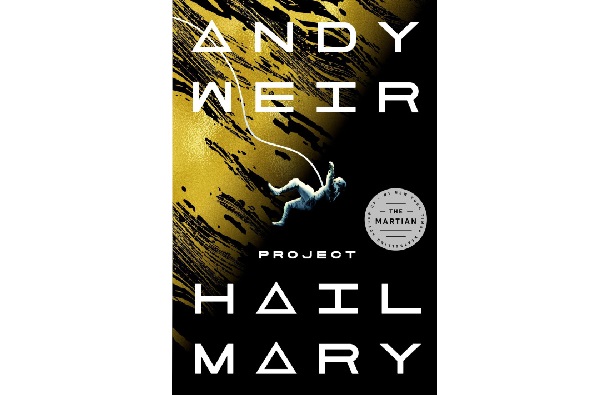
Andy Weir’s third novel is another testament to human ingenuity. It’s not perfect. It has its flaws. It also shows however, what every sci-fi hero should be like. Spoilers ahead!
Andy Weir is a little bit like Dan Brown. Is that an unfair comparison? Let me explain it a bit more.
Andy Weir’s debut novel The Martian came out in 2011 and earned a colossal amount of praise and recognition. It was turned into a pretty good movie with Matt Damon playing its charming protagonist Mark Watney. Movie Mark Watney was a wise-cracking nerd-jock, space farmer, space pirate astronaut. He felt like as if NASA commissioned Marvel to make a superhero movie that can make astronauts look cool. Book Mark Watney, however, was an even bigger nerd, a half-mechanic, half-engineer super-scientist everyman.
Weir later went on to publish his second book, Artemis, in 2017 to mixed reviews. The same kind of quippy jokes didn’t land. The plot was convoluted. The stakes were not as high either. And the complex societal setting that the story took place in didn’t really work well with Weir’s brand of characterization and humor. It felt like Mark Watney was turned into an attractive Saudi woman and put on the Moon.
And then came Project Hail Mary in 2021 and it started to crystalize Weir’s formula. If I wanted to build a sci-fi-novel-writing AI, this would be the final sample that it needed to create its Andy Weir algorithm. And that formula is this: Take a smart everyman competent white man hero. Throw him into a life-threatening situation in space. Make the setting strictly hard sci-fi. Give him clues and gadgets. Two-thirds of the way through, have everything go ridiculously, catastrophically wrong. Watch him struggle and science and engineer himself through everything while quipping the entire way. Give him some injuries, just enough so that we see that it hurts. Cheer him when he emerges victorious. Give it a cool title and repeat.
Another astronaut, out to save the world.
Project Hail Mary starts in medias res, even more so than The Martian did. Our protagonist wakes up in a sterile hospital room, with no memory of who he is, with two corpses lying on the adjacent beds. Having amnesia, our hero must figure out where he is, who he is, and what’s going on. Like hitting milestone achievements in a video game (which he himself remarks on), we learn with him the truth with every succesfully finished task unlocking another memory.
His name is Ryland Grace. He’s a high school science teacher. He’s on a spaceship. The Sun is dying. An extrasolar space microbe called the astrophage infected the solar system and it’s using up the sun’s luminosity at a rapid pace. The world’s governments came together to solce the crisis and to find a way to kill it. A stereotypical no-bullshit boss lady called Eva Stratt was put in charge of heading the whole thing. She recruited Ryland into the project based on thinly justified plot reasons. It was established that astronauts must go to Tau Ceti, the only nearby star system that seems to be immune to the star flu and science around to find the cure. And now Ryland, for reasons he still can’t explain, is on this spaceship, the aptly named Hail Mary. He was in hibernation for the multi-year journey it took to reach Tau Ceti. For some reason, his fellow astronauts died in their beds. He’s on a one-way trip, on his own, orbiting a distant star. He, and he alone, can save humanity.
The chapters follow a neatly paced structure in which the main storyline and flashbacks into Ryland’s memory follow each other back-to-back. For the most part, it works very well. Ryland establishes who he is, what he must do, how to do it and figures out that he only has enough fuel for one trip. This was always a suicide mission. And then he makes an exciting discovery. There’s a blip on his radar. Another spaceship, in the same solar system. An alien.
Soon after, Ryland makes contact and he and the alien learn to communicate. It’s a dog-sized, spider-like being, both male and female (which Ryland promptly starts referring to as “he” anyway). They build an unlikely friendship. Both of their solar systems are affected by the same star flu. Both of their entire crews died. They need each other to solve the mystery for both their planets.
Through some buddy cop sciencing and duct-tape problem solving, the two do just that, while their developing friendship must warm the hearts of even the most ardent critics. Things go bad, they get injured but still save the day.
The takeaway
Okay, so why is Andy Weir like Dan Brown? Well, here’s the thing. He has a formula. He has a competent man struggle his way through a cerebral adventure. That hero is a relatable everyman. A nerd who’s a little shy but still confident enough in his abilities to conquer all hardships with his brain, through pain and gritted teeth if need be.
But let me state that Project Hail Mary is a thoroughly enjoyable adventure. Andy Weir is best when his writing embodies a self-empowered can-do attitude. Does duct tape really fix that machine that does the thing with the oxygen? Sure it does. Great. Next problem.
Some of all of this will not necessarily age well. There are things in the story that we, men, still struggle with even if we have the best intentions. Why is an alien that’s both male and female, referred to as a he? Would the buddy cop chemistry not work if it was a they?
On the other hand, the boss lady in charge of the whole project who recruited Ryland, Eva Stratt, is visibly a figure from fantasy. A benevolent fantasy, true, but she’s a comically stereotypical iron lady all the same. It is clear that Weir is making efforts to include powerful, smart, competent women characters. But her strength and overstated stoic pragmatism comes across as abrasive, cruel and tyrannical. Not subjectively to the reader, but statedly, to the characters themselves. Even she acknowledges this and comes up with justifications for it. The survival of humanity hangs in the balance after all.
The Mythcreants blog posted an article in 2016 on the five signs of why a story might be sexist. And arguably, the easiest to fall into even with the best intentions is this: Powerful women being threatening to men. This is the case if women leaders do not feel normal, do not feel in line with a “natural order” but are rather outliers, exceptions in the story. Eva Stratt would probably be investigated, arrested, and sentenced for her ruthless methods if the literal fate of the world wasn’t at stake. When creating strong women characters, it’s easy to go overboard, to overcompensate. It’s easy to imagine a super powerful, super smart, ruthless Roman general war hero and make it a woman. But that won’t make her a compelling character.
She is also connected to another fallacy: The fantasy of the political strongman. We tend to think that in times of need, there must be one man, one tyrannical but competent leader who will save us all. This belief merits its own essay – For now I will just call it the “dictator fantasy,” because arguably, it’s rooted in Western culture as far back as antiquity. Hey if the puns are knocking at the door, we need a Scipio Africanus to save us all, don’t we? Or in this case, an Eva Stratt.
My main takeaway of this book however is that Project Hail Mary is a man’s ultimate fantasy, because it’s reasonable. It’s that you don’t have to fear the alien because you have no reason to.
The topic of why there are much more men in STEM fields than women is often a hotly debated one. And that’s because it’s hard to see from a male point of view the glass ceilings, the self-doubt that institutionalized norms instill in everyone else who is not a straight, white man.
In fiction, straight men are often depicted as the most aggressive characters. Military leaders. Politicians. Cowboys. Fighter pilots. But the male experience is that you don’t have to fight for everything. It’s that if you apply yourself, things will go your way. It’s that with hard work, you will always get the results. There is no self-doubt. No one will question your achievements.
It’s that if you’re a middle school teacher who wakes up with amnesia on a spaceship, with the fate of the world in your hands, you get to work because ultimately, you believe that if you set your mind to something, you can do it. And if you find an alien on the way, you approach it, explain what you’re trying to do, and the alien will be friendly to you.
This is not an attempt to bash this mindset. This should be cherished. But this is a privilege that not everyone has.
Ryland finds out that he alone can save the Earth. And he sets out to do it. He really isn’t sure that he’s the man for the job, but he doesn’t really doubt his own abilities that he can do it. When he finds the alien spaceship, he hails it almost immediately. Without doubt. Without fear of aggression. And what does the alien do? It acts reasonably. It immediately sees the benefit of working together and takes what Ryland says at face value, without doubt, without second-guessing.
The typical man’s perspective in Project Hail Mary is not that with brains and creativity you can persevere. Everyone can do that. The man’s approach is that if you see an alien, you reach out without fear, expecting it to act towards you reasonably. And the alien does. Because that’s the natural order of things. Because why wouldn’t it?
It’s naïve, but shouldn’t that be the norm? Those assumptions should be a privilege extended to everyone. That’s what women protagonists in future sci-fi adventures should also convey. Don’t doubt yourself. If you put in the work, you’ll succeed. See how this protagonist sees themself? Think like they do.
 PopCulture Station
Hozzászólás