Netflix’s new series took a bold step towards expanding the lore of The Witcher. And now there is one hotly debated topic we must face – But the answer to this question might be controversial. Warning: Spoilers ahead for the entire saga!
Let’s face it. Blood Origin is out now in the world. It’s fresh. It’s new. It’s also terrible. Probably. I have to make a confession, I was able to endure it for less than one episode before I decided that I would rather do anything, anything else, than keep watching it. Tidy up excel sheets. Put on a series of fitted sheets on matrasses. Watch bamboo grow. Anything else but watch Blood Origin.
On the second try, it wasn’t better. There will not be a third.
If you’re new to the entire Witcher saga, it’s a messy pile of books, video games and now two Netflix series that all take place in the same world, far apart from each other in time, all started by Polish writer Andrzej Sapkowski. But instead of discussing Blood Origin, let’s discuss this certain burning question about The Witcher 3 that fans will debate until the end of time.
What does the story of the video game The Witcher 3 have to do with Blood Origin? Absolutely nothing. But many fed up fans will probably redownload the games and start another playthrough to satisfy their need for nostalgia. And also, the English voice actor of Geralt from the games also recently weighed in on this controversial topic. So please, only keep reading if you have beaten the game or if you don’t mind heavy spoilers. Ready?
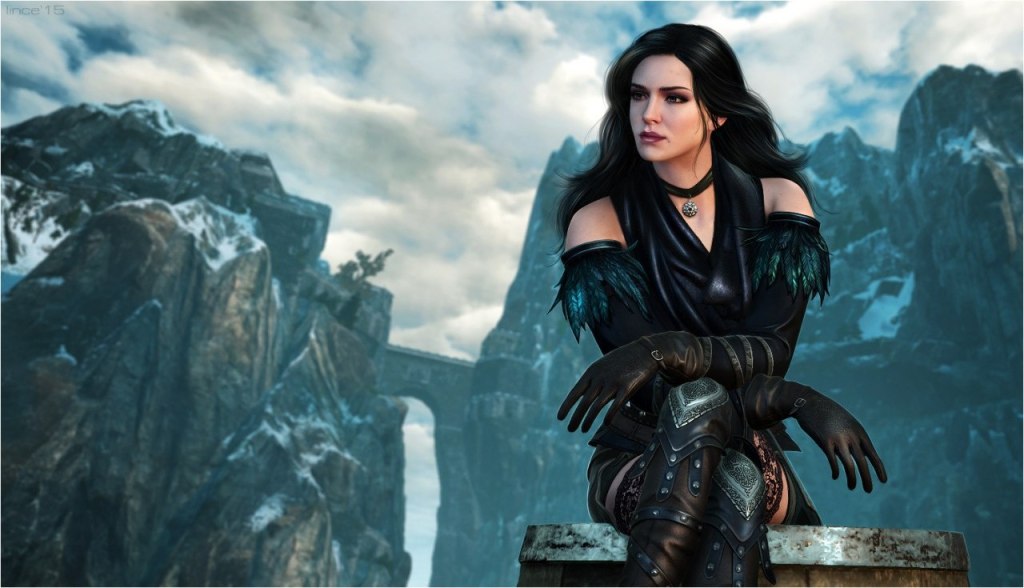
In the Witcher 3, Geralt has two main romantic interests. These are two sorceresses we also met in the series: Triss Merigold and Yennefer of Vengeberg. So, who’s the better romance option? Triss or Yennefer?
Let me tell you, the answer is definitely Yennefer.
This opinion is based on my vast knowledge gained from never having read the books and only having played the third game.
What makes Yennefer completely knock Triss out of the game? It’s not easy to answer that.
Let’s start with our protagonist, Geralt. What I’ve learned about Geralt throughout the game is that he is a man. And not in any macho sense of the word either: He is not just a grown man but an adult person. He takes responsibility, he makes adult decisions. He acts on principle rather than on impulse. He protects his friends and loved ones. He knows that he has limitations as well as that his actions have consequences. By he is a man, therefore, I mean he is a mature adult.
I’m saying this because the stark opposite of Geralt is Dandelion (Jaskier in the Netflix series). Sure, he’s funny. And of course, we believe that he has a heart of gold. (Although we see him through Geralt’s eyes.) But Dandelion is, if you look beyond the funny exterior, an immature, irresponsible man-child. He constantly needs someone to save him from the troubles that he gets himself into. He’s a womanizer with comments on women that really rubs you the wrong way. See, his story in the third game is a coming of age story, the womanizer bard growing up and settling down. Yet when he finally falls for someone, another bard called Priscilla, he calls her the crowning achievement of his womanizer career. That’s unbelievably condescending and demeaning. And yeah, sexist. But never mind that. The point is that Geralt is the protagonist and the kind if dad figure that solves everyone’s problems because he’s a responsible adult.
Which brings me to the ladies. And the two primary love interests in this game represent two different types of personalities.
Triss always seemed like she’s much younger than Yennefer. Younger and more cheerful. At first sight, more warm-hearted. The things that Geralt helps her get through, her troubles, they’re not her own fault. In fact, it’s probably it’s only Triss, Yen and Ciri whom Geralt doesn’t have to save from themselves in this game, ironically.
Regardless, Triss was always meant to be “the girl you save.” Even though she was a leader type of her own, she relied on Geralt, looked up to him. She was a little bit of a damsel. And there’s nothing wrong with that. It’s the classic “knight in shining armor” and “damsel in distress” story but the knight here is a monster-hunting Witcher and the damsel is a kickass sorceress and the leader of Novigrad’s underground magical runaway community.
Yennefer though, feels different. When Geralt interacts with her, she instantly feels like a partner, not someone you have to save. Not the girl that our hero shields protectively but rather, the woman who puts her shoulder to his shoulder, her back to his back. Even with her prickly behavior, there is warmth behind her ice queen façade. Matured love, softness, caring. That of a true long-time partner, an equal in every way.
There’s an interesting parallel between two moments in the game. At some point, Geralt goes to a formal reception/ball/soirée type of event with both sorceresses at different times. (With Triss, at a manor outside of Novigrad, with Yen, it’s on Skellige.) Both times, Geralt remarks that he doesn’t like doublets and formal wear and he finds it uncomfortable. The two sorceress’ answers however are different.
Triss: *chuckles* I’ll be sure to admire your valiant suffering!
Yennefer: Yes. You also dislike underdone meat and being teleported.
And those two answers carry in them the essence of the sorceress’ respective relationships with Geralt.
Triss is sweet, bur she has an idealized view of the Witcher. When you take her to the ball, it’s like a date in the very early stages of a relationship, sweet remarks, compliments, romance all the way.
As for Yennefer though, her behavior is that of a longtime partner. Like a girlfriend or a wife. She doesn’t look up to Geralt but looks at him like an equal partner and demands the same. She’s not as sweet as Triss, not as cheerful. It’s a different relationship.
Triss sends out Geralt to get proper clothes and masks for them both and cheers him for his effort. Yennefer prepares the arriving Geralt a set of evening attire, leaves it out on the bed and calmly compliments his outlook.
To Triss, Geralt is a date. Like a high school sweetheart that she can dream of going to the prom with.
But to Yennefer, Geralt is not an idealized center of romantic attention. To her he’s a longtime husband. They know and acknodledge each others’ faults as well as strengths and skills. Together they are a power couple, two different but equally unstoppable forces of nature.
So if Geralt is a dad figure, a problem-solver, a savior, a moral compass, Yennefer is a mom figure. Uncompromising, deadly, strong-willed, resilient, resourceful. She has the same type of mature, adult outlook on life that Geralt has.
And when these two join forces to race with time and magical death metal elves to save their adoptive daughter, it feels like no matter who stands against them, it’s Geralt and Yennefer, coming to save their child, who are the two most dangerous people on any battlefield. Becuase if you hurt their family in any way, I hope you’re in heaven half an hour before Geralt and Yennefer find you. And that’s the compelling story that I’m here for.
 PopCulture Station
Hozzászólás