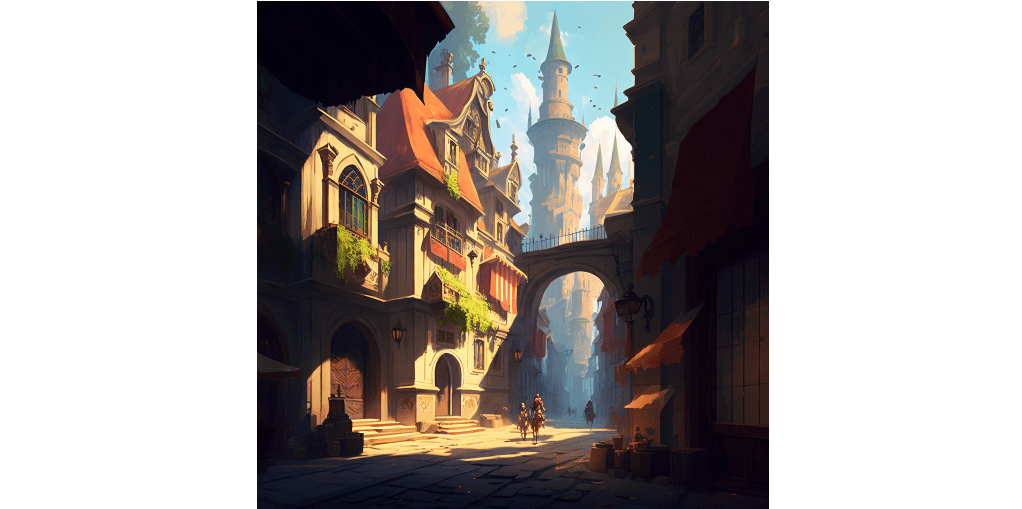
Fantasy is making a comeback. Not urban fantasy, with its sexy vampires and half naked werewolves that dominated the 2000s-2010s and the imagination of teenage Millennials. No, the sword-and-sorcery kind, the one with kingdoms, dragons, wizards and knights. Why this trend started is not that easy to tell. After all, goofy fantasy series and abysmal film adaptations in the 1980s-1990s seemed to have driven the genre into the ground for good.
After Game of Thrones threw the gate open for fantasy again, many studios and creators scrambled to follow. With the dark months of the pandemic lockdowns, tabletop roleplaying games like D&D made a comeback. Success stories like the meteoric rise of Critical Role have been possible. We have The Legend of Vox Machina, we have The Witcher series, we have everything from The Wheel of Time to The Rings of Power. Sword-and-sorcery high fantasy is with us again.
And yet there still are old tropes that exist in fantasy today. There are misconceptions which tie the hands of creators. Moving past them might just create opportunities to tell newer, fresher, exciting novel fantasy stories.
Societies are frozen in time
One almost universal issue with fantasy worlds is that societal progress is either incrementally slow or has halted entirely. Kingdoms and empires stay exactly the same for very long stretches of time, sometimes centuries or even millennia. To make things worse (and easier for the reader/viewer/player to understand), the same ruling family usually rules over the same land for eons. Fantasy history usually involves various cataclysmic events to which time-keeping is dated back. These probably borrow from real-world examples like the fall of the Western Roman Empire or the Late Bronze Age collapse. However, after the initial pacification/rebuilding period, fictional societies stay the same.
This is probably due to the fact that fantasy authors are history fans themselves, but not historians. They usually also don’t come from a social or political science background.
Very often, like in the case of Game of Thrones, the author explains that technological development is conveniently halted by magic. And the development of society naturally halts too. Borders, ruling families, political factions, even fashion remains the same for centuries.
There is a misconception at the heart of this problem. The idea that withoutscientific and technological development, human societies stay the same.
Societies constantly develop and change. They go through crises. If you look at our own world, you can see how every decade is different, and in turn how every century brings about massive changes. Societal norms, in politics, in culture, law, the economy, everything changes over time. And new crises emerge. Look at desegregation in America, the Civil rights movement in the 1950s and 60s. Today’s growing inequality. The increasingly dire socio-economic state of the middle class. The growing income discrepancy, the housing crisis. All of these changes are socio-economic in nature, and none of them will be solved by one miraculous technology.
Civilization builds and progresses on its own. After the Bronze Age Collapse, it took a few centuries for societies to bounce back and new ones to form. Small communities grew to become city-states. Empires slowly took over. Finally, under Rome, the whole of the Mediterranean became a unified global economy and a multiethnic political union.
All of these things happened within a timespan of roughly 1500 years. In this gradual coalescence, new technologies definitely played a role in trade, in warfare, in everyday life. But societal progress was advanced by everyday people. By workers building roads. By lawyers arguing court cases, traders establishing trade routes. Surplus resources led to new luxuries, bigger armies, better disaster management, art, science, culture, better administration, and security.
What this shows is that it would enhance fantasy worlds to base their histories on a depth of societal, economic and political progression which is dynamic in its nature. Fantasy is about people in a fantastic setting. And people just build bigger and more efficient societies over time. Societies that change year after year.
Polytheism being fantasy Christianity
Fantasy authors love to make up cool and exciting gods. They then create miniature Medieval churches around them. These end up being reflavored, miniature clones of the Catholic church. The colors and symbols are swapped out, some tenets and virtues are changed. But they’re pretty much all the same. They have very Christian-looking clergies (even with the celibacy clause in some cases, except for the sexy, sexy priestesses of the love goddess). They all offer personal salvation in exchange for personal devotion and a morally righteous life. These deities are canonized, their pantheons are unified, and they are uniformly worshipped in the same form, albeit sometimes under different and exotic names in the Exotic Places.
It’s understandable. Authors, players, viewers, readers never knew anything aside from staunch monotheism. In some cases, Christianity was even an inspiration for modern fantasy. It is entirely understandable how the concept of religion is hard to grasp outside of the Judeo-Christian (or Muslim) heritage.
But actual polytheism offers so much more variety and exciting opportunities to explore. In antiquity, deities didn’t have dedicated churches that spanned regions, that’s a Christian invention and it explains a lot of how Christianity survived in its first couple of centuries.
Greek and Roman gods were worshipped and venerated at festivals. They had cults. Some cults were even mystery cults, which were often hard to get into. They had temples that only their priests could enter, and statues that were, for all intents and purposes, the gods themselves. Polytheistic people entered into agreements with their gods, they offered sacrifices and festivals for military success and a bountiful harvest. Don’t imagine praying to a benevolent, omnipotent savior. Imagine paying tribute to a divine godfather or godmother. Priesthood was very often hereditary.
Even the gods themselves weren’t uniform. The same gods were worshipped in a variety of ways in various places. In some places, they absorbed other gods. Local gods. More ancient gods. In classical antiquity, the Goddess Aphrodite might seem like a universally agreed upon figure. A mercurial, temperamental goddess of lust and love and sex. It’s tempting to embellish that picture, adapt her as a sexy love goddess into a fantasy world, make her priestesses divine courtesans. However, in other rites and cults, Aphrodite was the goddess of non-physical, spiritual love. In some other places, there were even cults of a bearded Aphrodite, which tells a lot about gender and sexuality in the ancient world. And yet in other places (most prominently, Sparta), Aphrodite was a war goddess, whose statue depicted her wearing armor, helmet, and carrying spear and shield.
Understanding these concepts presents new opportunities. Fictional worlds could gain a lot of depth and expand in new dimensions if fantasy polytheism was based on how actual real-world polytheism worked.
Filthy Barbarians and noble savages
The misconception of Barbarian peoples goes back to the Greco-Roman world. It was actually preserved in some form well into early modernity, which is one of the reasons why the civilizing mission political ideology of colonization. The one that says civilized civilizations should really civilized the thoroughly uncivilized savages, barbarians, natives.
This is more than just the Barbarian trope. From the point of view of the Romans and the Greeks, civilized people were the ones who lived in the Greco-Roman cities and did the Greco-Roman things. So, basically, Romans and Greeks. (According to the Romans.) Or just Greeks. (According to the Greeks.) Later, British, French, Spanish, Dutch colonizers made the same distinction. Over the centuries, many other cultures, peoples, ethnicities were just swept into the same category: The uncivilized savages.
In contemporary fantasy, the barbarian trope took a turn and went into a different direction. The romantic Noble Savage trope led to fictional forest peoples becoming fantasy Celts with druids, stone circles and nature magic. The fantastical Medieval recounts of Viking berserkers, or Scottish hill tribes, or Germanic raiders trickled down into modern historical fiction and high fantasy. Works like Conan, the Barbarian (the Schwarzenegger version), Red Sonia, Hercules, Xena the Warrior Princess informed our fantasy understanding of barbarians, as a whole.
But the trope, and the connecting misconception of “barbaric” cultures is dangerous. It puts actual historical peoples in a box and reinforces the “civilization vs savages” ideology. When fantasy races enter the equation, they are often swept into this cultural simplification. Going back to Tolkien’s concept on races (which did not age well), orcs are usually the brutish, strong, slow, and dumb barbarians. D&D’s goliaths are a unique mixture of the barbarian and noble savage tropes. Elves are either fantasy celts, or highly refined and treacherous movers of the Evil Empire.
If we look at the real-world inspiration of most Barbaric peoples in fiction, we find peoples with depth, having their own culture, economy, societal stratification. Their technologies are usually the same as what “civilized” peoples of the respective period used.
Modern fantasy could adapt these Barbarians in a much more complex fashion. Tribes could have alliances and trade networks. Their own nobility. Cities, agriculture, technology, religion. Traders, crafters, priests. The modern Barbarian warrior could be a member of the elite bodyguard of the tribal king, or a highly trained child of the rich warrior-elite who went on an adventure to gain experience. The druid could be an apprentice of the priestly elite, a scholar who is trained in administration and astronomy, not just trees and nature magic.
All in all, our modern high fantasy is changing. A genre of modern fantasy is emerging, which is more diverse, has a healthier outlook on race and culture. And yet there still are tropes stemming from 19th and 20th century misconceptions on fiction writing based on real-world history. Moving past these misconceptions could open the door for a new wave of fiction in contemporary popular culture.
Image credit: Cover art by Midjourney, under the Creative Commons Noncommercial 4.0 Attribution International License
 PopCulture Station
Hozzászólás