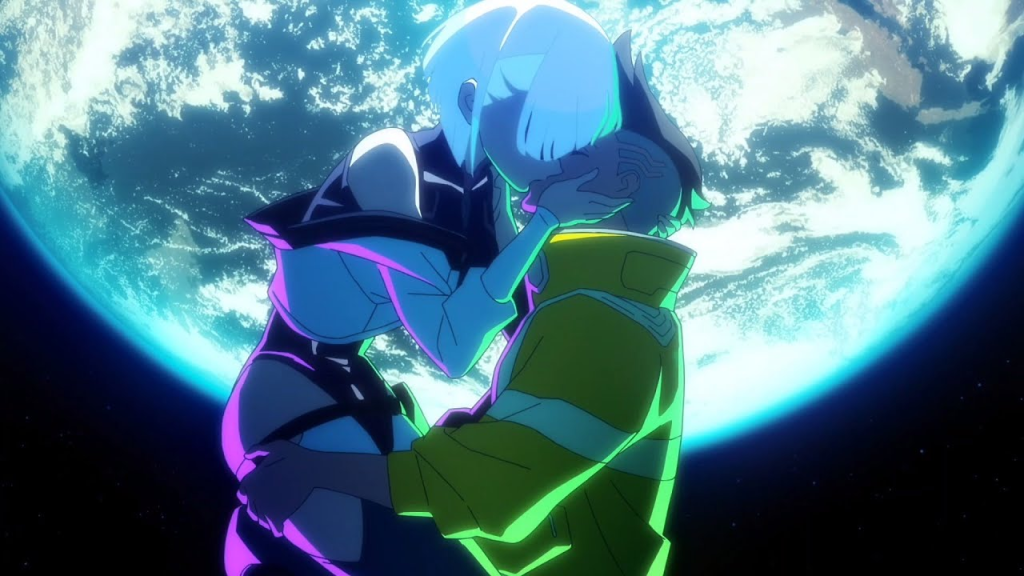
The loud, foulmouthed little sibling to CD Projekt Red’s Cyberpunk 2077 is out, trying to save the family name. And to everyone’s surprise, it is one of the biggest hits of this fall. The world of Night City has never been this immersive, this believable. And at the core of this is a compelling story of loyalty, belonging, love and acceptance. This story sneakily proves one thing: Men really love romance. You just have to hide it under layers of neon light, action sequences, cybernetic femme fatales and highway shootouts to mask it as a sci-fi action-thriller. Spoilers ahead!
Two years after Cyberpunk 2077 got released, (and maybe six months after the game actually started living up to the expectations), came Edgerunners, the videogame’s standalone companion series.
It hit Netflix’s front page just in time to drive up the hype for a newly patched and finally (mostly) finished game. And just in time to bring attention Cyberpunk 2077’s one and only DLC sometime next year.
At first, the series might ironically seem like a tool for corporate PR, made to repair the battered Cyberpunk 2077 brand. The first scenes offer up gratuitous violence and lore-appropriate gadget nerdiness. We are also immediately hit by the looks, sounds, and feel of Night City. ‘Member your crazy adventures in this place? Hey you used to drive around this neighborhood!
However, the story seizes your attention after you get to know protagonist David Martinez. Within one episode it not only manages to stand on its own two feet but rather, hits the ground running.
When you meet him, David seems like a typical anime protagonist. He’s loud, vaguely aggressive, an underdog with a chip on his shoulder and something to prove in the world. He’s the archetypical young man dreamed up to gain the sympathy of every boy and man from the age of six and up. However, the story takes David through trauma, growth, drama, character development and more trauma. Halfway through the first episode, it starts playing with the viewer’s heartstrings. By that time, it already got its audience hooked.
The world
By any estimate, Night City should have been deserted decades ago. Corporate warfare, terrorism, highway shootouts with massive civilian casualties are commonplace here. However, unlike in Altered Carbon, the city is not just a neon-grimdark dystopian backdrop to the series. From phone ringtones through the annoying sound of the pedestrian crossings, through the cars, to the city layout, the studio Trigger took everything from the original game and turned it into a believable, tangible world.

They did this to the point where one can almost feel the heat of the sun radiating back from the concrete of the empty canals. You can almost smell the way the asphalt smells during a summer storm. They did some trimming tooo though. The game builds on an incorporated 80s aesthetic. It also has a layer of weird internet culture from the song Ponpon Shit and heavy metal to dildos that can be brandished as bludgeoning weapons. The series does trim this to an extent, staying in a more familiar, more traditional, neon-soaked cyberpunk lane.
What is important though, is that the societal backdrop is not just believable but also, intriguing. Corporations fight endless proxy wars through mercenaries they use and then discard. You can see how this was originally meant to be an interactive setting for the tabletop rpg Cyberpunk 2020. Because as the world of Night City unfolds around you, you can’t not want jump into the action with a character of your own.
In this, the city actually resembles The World of Darkness to a surprising extent. and you just can’t help but blow a chef’s kiss as you see the backdrop character study of the city itself unfold. This is a study of power and corruption that drives a secondary message home. There is always a city, there are always power brokers, and young men and women always die for old, rich aristocrats’ ambition.
Now, speaking of Altered Carbon, the question of how much cyberpunk as a genre still reflects our society’s deepest anxieties and fears is a valid one. How much has it become escapist fantasy instead of a dystopian mirror? I want to give this topic its own space to discuss in detail in the future. However, in Edgerunners there is more behind the colorful, hyperviolent, sometimes overly sexualized surface of Night City.
You can see the familiar issues: Class tension, privilege vs disenfranchisement. The closing of social mobility and the late-stage capitalism failure of the welfare state. Yes, Night City is a good vacation spot. It is also a place where the paramedics will let you bleed out on the pavement if you don’t have premium Trauma Team membership.
The characters
Into this violent world steps our protagonist, David Martinez. David is frustrated. He hates the elite prep school of the Arasaka megacorporation. The prep school that his mother Gloria is sacrificing everything to put him through. And he really, really wants to prove himself and belong somewhere. This is a central character trait which will resonate with many viewers. As does David’s other cardinal trait: He needs love.

“My son at Arasaka Tower, top floor! I can just see it.”
The loss of his mother shocks young David to the core. That’s when he meets mysterious hacker Lucy and the mercenary gang she belongs to. After that, it takes no time for him to switch careers from mostly innocent high school dropout to rookie merc. David finds a mentor/parent figure in their leader Maine, and the archetypical juvenile anime character roster that is their mercenary company brings a sense of family into David’s life.
While the characters are often archetypical and predictable, they are never one-dimensional or boring. Through a combination of authentic story beats, a compelling narrative and just great characterization from the animators to the voice actors, David and his fellow high-functioning lunatics become lovable and grounded people. Especially once the series starts trimming the crew and the select ones that remain get more attention.
The story
When he loses his mother, David finds a military-grade cybernetic implant among her belongings. This is a sandevistan, a dangerous but very effective weapon. It turns out that his mother, who was a paramedic and probably had access to crime scenes, used to sell implants like this on the black market. She used the money to put her son through school. David has the sandevistan installed and finds out that he has an unusually high tolerance for implants. That’s why Maine, the mercenary leader to whom Gloria intended to sell the implant, takes mercy on the boy and takes him in.
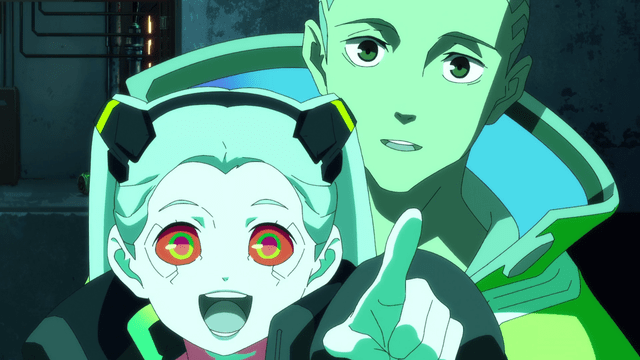
As he goes through the learning curve of an amateur rookie, we see a coming-of-age story bloom. And David’s happy days are peppered with the joys of Night City’s eternal summer: Gang violence, chase scenes and his blossoming young love with Lucy.
The fast-paced character drama, thriller, and explosive action do make Edgerunners an exciting ride. Yet the love story hidden under high-energy explosions of gore and violence is the beating heart of the series. This beautifully collides with the gritty realism of Night City’s cutthroat, corporate urban jungle.
David keeps losing people, despite everything. All his talents, unusual cyber-tolerance and military combat cybernetics can’t help him save himself or his friends. This could be a jaded commentary on the inevitable, soul-destroying doom of the capitalist dystopia. However, the quality of the characters and their interactions actually bring a certain pathos to the story. An air reminiscent of Greek tragedies.
Halfway through the season, David’s mentor, Maine, falls victim to cyberpsychosis. Cyberpsychosis is more than an occupational hazard. For “mercs,” and “chrome jockies,” this disease is the boogeyman. It’s the mental break one experiences when their cybernetic modifications are finally pushed beyond their limit. This is what David’s unusual tolerance can help stave off for longer – Making him the perfect mercenary edgerunner.
When Maine eventually falls victim to the disease, our protagonist steps up as a further cyber-enhanced (and in the process, heavily Himbo-ized) mercenary leader. He is competent. He is cool under pressure. He is more mature now. And yet, deep down, David is driven by the loss of his mother, the loss of Maine, and his devotion to his girlfriend, Lucy. One piece of beautiful symbolism in the series is how David keeps his Gloria’s paramedic jacket. He wears it every day and it becomes the centerpiece of his iconic outfit. This yellow jacket literally spells out how even after her passing, David wraps himself in his mother’s love.
David pushes himself further and further. And even his unusually high tolerance for cybernetics can’t stave off the signs of cyberpsychosis forever. One central moment in his slow descent into eventual cyberpsychosis is when David murders an Arasaka employee. It is a moment of madness for him on a mission gone wrong, an episode of his developing cyberpsychosis. But he stands above the corpse of an innocent woman, and he finds out that he killed a mother on her way home for her son’s graduation. The ensuing guilt brings up memories of his own mother. And it shows how a cycle of violence disrupts and destroys people, leaving them to pick up the pieces however they can.
Eventually, the tangled web of corporate espionage and shadow warfare catches up with him and his crew.
In the end, as his mind slips closer to breaking, it’s memories of his mother Gloria, and his girlfriend Lucy that keep David on the right side of sanity. At least long enough for the action-packed final battle at Arasaka Tower.
In that heart-wrenching finale, David sacrifices himself to buy Lucy her freedom, and he goes down in a blaze of glory. The ending drives home the message that only only love matters in a world where everything else, including human life, is quantified, purchased and discarded as trash by the next dawn in Night City.
And for this reason, instead of being a jaded and cynical commentary on power and violence, Edgerunners is, at its core, a bittersweet love story.
My takeaway
Edgerunners hit my friend group and my social circles with an unexpected vibe check. And what I immediately saw was how fellow men reacted to it – Going through a raw emotional whiplash.

It seems like Edgerunners really proved one thing. It’s not that Cyberpunk 2077 is salvageable (which we knew) but rather it’s that men actually really love romance. And the reason for this is that this series just got David and his relationships so right that it hit something primal in us. And for that, we are willing to overlook juvenile anime shenanigans, often gratuitous oversexualization and violence.
David is continuously described as hot-headed and reckless. A more subtle trait of his personality is how much he is dependent on the love and emotional support of his mother. And how Maine, his new crew, and primarily, Lucy filled the hole left behind when Gloria died.
And so while the story has many layers, meanings and purposes, I think that the thesis of Cyberpunk: Edgerunners can be boiled down to this: The mental health of men depend so much on belonging, on being valued, and most importantly, on being loved. And that’s a very important message.
 PopCulture Station
Hozzászólás a(z) Crusader Kings 3: Come for the crusading, stay for the Medieval dating simulator… and the glory of Rome – PopCulture Station bejegyzéshez Kilépés a válaszból