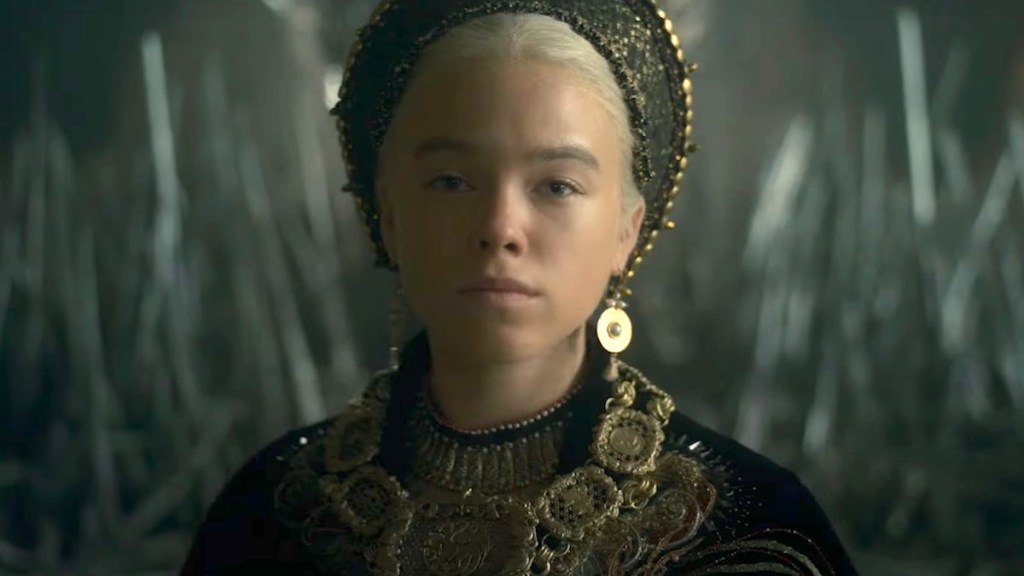
House of the Dragon is a story about a succesion crisis, in a fantasy world drawing clear inspiration from the feudal struggles of Medieval Europe. History teaches us that crowns are often passed on involving violent conflict. Yet there have been examples of lasting regimes and dynasties, led by rulers who understood the nature of power. Two of these examples are the Roman Empire and Medieval France. Both of these realms faced periods of potential upheaval, during which, they could have been plunged into succession crises similar to the one House of the Dragon depicts. Through intelligent measures and foresight, both were able to avoid some of their potentially worst crises. This shows us that with a better plan and the right groundwork, Rhaenyra Targaryen’s succession could also have been ensured – And the devastating civil war coould have been avoided.
What a gorgeous sight it is to see a dragon soaring through the sky. It is also a perfect symbolism for the heights from which the great and terrible might fall due to their own hubris. Or, better yet, due to their inability to build a lasting regime.
As we watched the first episode of House of the Dragon in 2022, which depicted the events of 105 AC, 170-plus years before the birth of Daenerys Targaryen, we got a tasting of everything the series had in store. Gore, blood, dragons, intrigue, frustration, drama, sacrifice, and death, lots and lots of death. Soon, we saw a wary and grieving King Viserys (Paddy Considine), numb from the loss of his wife and a stillborn son, finally acknowledge the perfectly good heir in front of him that he had all this time. This was no other than the princess we saw soar through the skies on the back of her dragon earlier, Rhaenyra Targaryen (Milly Alcock/Emma D’Arcy). In an unprecedented move, the king made her his heir. Unprecedented, because she was a woman.
Understandably, the politics of Westeros being the exact same as the politics of our world today, this outraged almost everyone. It put the Realm on a collision course with disaster. The characters have been put into trajectories that would eventually lead them into a civil war. Nothing to be done about it. Or is there?
The heir who has no room to grow
Upon adopting Rhaenyra as heir to the throne, King Viserys, knowing that the Realm might not accept an unprecedented ruling queen, has practically all of the nobility swear a new oath of allegiance to him and to his heir, Rhaenyra. And then, convinced that he did everything he could he tasks Rhaenyra with doing everything that a royal consort is supposed to do: Start making babies. Meanwhile, he lets her do zero of what an actual future ruler must do: Learn to rule, build her own base of power, her own networks of influence, gain prestige and influence, and get ready to step into her role as queen when he dies. This will happen sooner rather than later as starting with the first episode, King Viserys is shown to suffer from a vaguely leprosy-like disease, putting an expiration date on his reign.
Fans tend to praise King Viserys for his dedication to his family and his last-ditch defense of his daughter when, later in the season, the severely sick and disfigured king gets out of his bed to sit the throne one last time and defend his daughter and her family from the circling vultures ready to take her down. However, this is the same universe as Game of Thrones. Characters’ downfalls are not caused by good or bad intentions, but as a rule, smart people (and their families) survive, while dumb decisions get people killed. And at this point, even though the old king is still alive, Rhaenyra’s future reign is already doomed.
See the thing about ruling as a sovereign in a feudal kingdom is that it takes talent, skill, luck and bravery to stay alive. It takes connections, good alliances, and a lot of administrative and diplomatic work and backroom dealings however to be good at it.
In Game of Thrones, Lord Varys famously equated power with a shadow on the wall, a breathtakingly clever and sharp postmodernist interpretation of the nature of power, one that an academic paper might unfold and digest in depth. But to sum up the important parts, a lot of cultural and societal factors are in place even in the face of the most hardcore hard power, a fact that is driven home by the case study of Aegon the Conqueror himself, who not only used dragons to defeat the kingdoms of Westeros, but also used a lot of politicking, the endorsement of the Faith, and the gradual winning over of the nobility of Westeros to be able to forge the Realm. Even if you have three large flying weapons of mass destruction, people still need to get on board with the new regime, they need to get invested, their loyalties ensured through a series of deals, concessions, and a gradual establishment of a system that over many years becomes entrenched not just through coercion and hard power but also of through the sheer inertia of mundane routine.
This is where Viserys fails. The old king delegates his new heir to the position of cup-bearer, and we watch with frustration as the would-be future ruler of the Seven Kingdoms and heir of Aegon the Conqueror does nothing more serious than fill the cups of men sitting around the Small Council table, unable to participate in the actual day to day business of governance. There is much more that she could have, and should have, done.
A way to ensure a smoother transition: Crown them as junior ruler
In the real world, there have been various examples of rulers gradually building up their heirs to near-equal or even equal levels of authority and power before their succession. After decades of turning the Roman Republic into the Roman Empire, the first emperor, Augustus himself, brought up his eventual heir Tiberius to the same level of authority as himself. This happened after the aging emperor ran out of other heir candidates, and he had to turn to his estranged stepson to trust him with the future of his new empire. This took years. It started with Tiberius’s official adoption in 4 AD, followed by a gradual granting of powers, (or re-granting to a large extent, following lots of melodrama involving a long self-imposed exile by Tiberius). Eventually, in AD 13, Tiberius was made equal with Augustus as princeps (the early title of the emperors). This was especially important because of the novel nature of the imperial regime.
During a particularly difficult period three hundred years later, the Roman Empire was able to survive after the Crisis of the Third Century because, for a time, a domineering emperor put into place a new system of power. This unique power sharing arrangemen, put into place in 293 AD by Diocletian, was called the Tetrarchy, the first step towards the division of the empire into a Western and an Eastern half, the latter being called the Byzantine Empire after the fall of the West in 476 AD. The Tetrarchy was unique in that not one, not two, but four emperors were elevated to lead Rome. Two senior emperors (augusti) for East and West, respectively, and two junior colleagues (caesars) as eventual successors. And while the system was later completely dismantled by Constantine the Great, the idea of junior rulers did not disappear.
A perhaps more direct parallel to Westeros is medieval France. In 987, following the failure of the imperial Carolingian house in Western Francia, a new dynasty, the Capetians rose to the throne. While the reestablishment of the Frankish Empire, effectively the Western Empire was still possible in the 10th century, the parts of the Empire were moving in different directions, on a course that would see the Eastern half of this empire consolidate into the Holy Roman Empire, and the Western half into France. The House of Capet had a cardinal role in turning West Francia into France. And a useful trick that the early rulers of the then young and (comparatively) weak Capetian house did was the coronation of junior kings.
Hugh Capet crowned his son and heir, Robert, junior king in 987, a position that he held until 996. For the entirety of his father’s reign, he helped stabilize a shaky new regime, and he built a career as a ruler, military commander, and politician himself. The kings that followed Robert had much less time as junior kings, but they were all at least crowned during their respective father’s reign.
Looking back at the Targaryens in House of the Dragon, it is clear what a glaring error it was by Viserys to keep Rhaenyra away from the throne, robbing her of all opportunities to get experience, get some early victories under her belt, and crucially, the ability to build a career as a ruler, to build her own power base, make her own deals and gather a loyal following, and a network of connections and influence.
The regime must be built brick by brick, not by a single oath
Viserys named Rhaenyra his heir, but he looked at her as his daughter, and a woman in a patriarchal society, not as anything close to a ruling princess, even though her possession of Dragonstone actually made her one of the great nobles of the Realm in her own right.
And if the king wanted to give his daughter the best chance at succeeding as a ruling queen, then instead of fixating on her family affairs, he should have immediately included her in the Small Council the day after her appointment as heir. He should have helped her take control of Dragonstone immediately, and should have gradually given her more and more land and power to be able to foster a network of clients and vassals personally loyal to her.
Just as importantly, he should have had her physically present in the throne room, on hunts, at every formal occasion, by his side. Visually, she should have stood by the throne, above the other Council members, by the king’s side. This was even more important after the birth of Viserys’s last child, a son that could challenge Rhaenyra.
For years, she should have gained experience as a member of his Small Council; then eventually, he should have named her Hand of the King. After this, gradually, some of the royal titles could have been delegated to her (Protector of the Realm for example, the chief military commander of the Seven Kingdoms). She should have been given the chance to learn about military command, about taxes, about handling crises, in which she should have been given a gradually larger and larger role.
Finally, since he already broke tradition by naming her heir, Viserys should have had Rhaenyra crowned by the High Septon as junior sovereign, and eventually, he should have abdicated in her favor during his own lifetime, ensuring the completion of a peaceful transition of power.
This would have taken years, maybe decades – Time that Viserys did have when he named Rhaenyra his heir. But all of this, the mundane work, the backroom dealing, the politicking, the everyday tasks of going through tax reports and troop deployments and promotions and staff appointments, n other words, the everyday job of governing and building a regime, is just as important as the dragons, perhaps even more so. This is why Otto Hightower and his faction was able to step into the power vacuum following the King’s death. Nothing else was in place, and he had the decades of experience behind him, combined with the wealth of connections, owed favors, deals, clients, a network of power that he built over the years. With no dragons, no titles, no armies, he went from overlooked second son of a great house to the second most powerful man in the Realm. His ceasing of power through the king’s younger child as a puppet king was only natural.
So if you happen to be in the position of staring down the barrel of a potential succession crisis, and you want to give your heir the best possible chance, don’t rob them of possibilities of actually contributing to your regime. Much like any other endeavor, governance requires hard-earned experience, skill, and connections. A future ruler has to have time to learn the ropes of ruling, and they need to make their future subjects get on with the regime, with or without a dragon.


Hozzászólás